
If you have ever crouched down next to your Tesla with a torque wrench or a tire iron, you have probably asked yourself: do Tesla wheel covers block lug nuts? It is a fair question. On most gas cars, cheap plastic hubcaps hide the lugs behind a maze of clips, and touching them feels like a gamble. Tesla’s covers work differently — and once you understand the design, servicing your wheels becomes refreshingly simple.
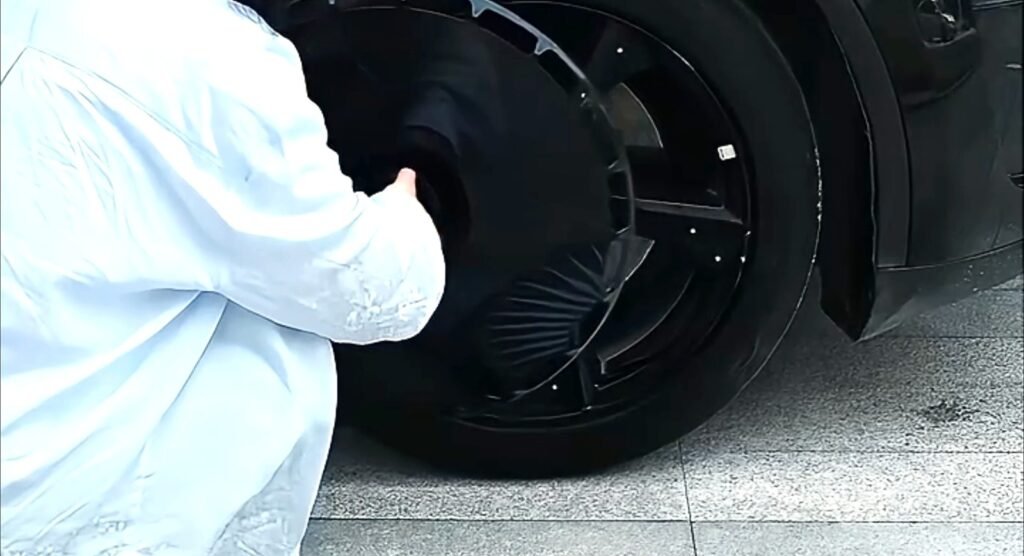
In this guide, we will break down exactly how Tesla wheel cover designs handle lug nut access, when you need to pull a cover off, and what to check before you buy an aftermarket set. If you are shopping for a new look, the full range of Tesla wheel covers at Nauticrim is designed with the same service-friendly logic in mind.
Do Tesla Wheel Covers Block Lug Nuts? The Short Answer
No — Tesla wheel covers do not block lug nut access in any meaningful way. On Model 3 and Model Y aero covers, the factory design leaves a recessed center channel or uses clip-on geometry that lets a service technician (or you) reach the lugs with standard tools. On many trim levels, the aero cover pops off in seconds, revealing the alloy wheel and lug nuts underneath.
That said, “not blocked” does not always mean “never touch the cover.” Whether you can torque the lugs with the cover installed depends on your specific wheel and cover style. When in doubt, removing the cover first is always the safe move — and it takes about ten seconds per wheel.
Why Lug Nut Access Matters on a Tesla
Wheel covers sit directly over the fastest-moving, hardest-working part of your car. You need clear access to the lug nuts for several routine situations:
- Tire rotation — Tesla recommends rotating your tires every 6,250 miles (10,000 km) or when tread depth differs by 2/32 inch between tires.
- Seasonal tire swaps — winter and summer wheel sets mean pulling covers on and off twice a year.
- Flat tire service — roadside help or a mobile technician needs fast access to the lugs.
- Brake work — pads and rotors are easier to inspect and replace with the cover out of the way.
- Torque checks — after any wheel service, lugs should be re-torqued to Tesla’s specification (129 lb-ft / 175 Nm for most Model 3 and Model Y wheels).
A cover that fights you during any of these jobs turns a five-minute task into a frustrating afternoon. This is one area where Tesla’s engineered approach clearly differs from the cheap universal hubcaps you find at auto parts stores.
How Tesla Wheel Cover Design Keeps the Lug Nuts Reachable
Factory Tesla aero covers are built around the wheel underneath them. Three design details make lug nut access straightforward:
- Center bore opening. Most Tesla aero covers leave the center hub area open or lightly covered, so a socket can reach the lugs without removing anything.
- Quick-release clip geometry. The covers use flexible plastic clips around the rim edge — pull firmly and evenly, and the cover pops free without tools.
- Lightweight construction. A Model 3 or Model Y aero cover weighs far less than a steel hubcap assembly, so removal is a one-handed job once you know the technique.
If you want a refresher on the removal technique itself, our step-by-step guide on how to remove Tesla aero wheel covers safely walks through the pull points and the mistakes to avoid, like yanking from one edge and stressing the clips.
When You Should Remove the Cover Anyway
Even when the lug nuts are technically reachable, there are good reasons to take the cover off before wheel service:
- Accurate torque. A socket seated through a cover opening can sit at a slight angle. Removing the cover guarantees a straight, true seat on every lug.
- Protecting the finish. Torque wrenches and impact guns can scuff or crack a cover’s edge if it stays installed during service.
- Full inspection. With the cover off, you can check the wheel surface, valve stem, and clip condition at the same time.
- Cleaner work. Brake dust and road grime hide behind covers; pulling them off keeps the job tidy and lets you clean both surfaces.
Think of the cover as a garment you take off before the mechanic arrives — not because it blocks the work, but because it protects the finish and makes every step cleaner.
Do Aftermarket Tesla Wheel Covers Block Lug Nuts?
This is where quality matters. Well-designed aftermarket covers follow the same philosophy as the factory parts: model-specific fitment, clip systems aligned with the wheel’s retention points, and an open or accessible hub area. Poorly made universal covers, on the other hand, often bury the lugs under thick plastic with no service thought at all.
Before buying, check three things:
- Confirm model and wheel size fitment. A cover built for your exact wheel (18, 19, or 20 inch) aligns correctly with the lug area. Our Tesla wheel cover size guide covers every fitment detail.
- Look at the hub design. Product photos should show either an open center or a documented way to access the lugs.
- Prefer clip systems over adhesive or zip ties. Anything glued or zip-tied over the wheel will make every tire rotation harder than it needs to be.
Every set in the Nauticrim turbine wheel cover collection uses a clip-on system matched to factory wheel geometry, so lug access stays as easy as it is on the stock aero covers.
Quick Tips for Wheel Service Day
- Pop the covers off before the car goes on the lift — it takes two minutes for all four wheels.
- Store covers flat in a soft bag; stacking them face-down risks scratching the face finish.
- Check each cover’s clips while the wheels are exposed; replace any cracked clip before it causes a rattle or a mid-drive failure.
- After service, seat the cover evenly around the rim edge until every clip clicks, then give the face a firm push test.
Can I rotate my Tesla tires without removing the wheel covers?
On many factory setups, yes — the lugs are reachable through the cover’s center opening. But for accurate torque and to protect the cover finish, most owners and technicians simply pop the covers off first. It adds under a minute per wheel and removes all risk of scuffing the cover with a wrench.
Do aftermarket wheel covers hide the lug nuts completely?
Quality Tesla-specific covers do not. They are molded around the wheel’s factory geometry, leaving the center hub open or easily accessible. Avoid cheap universal “hubcap style” covers that fully enclose the wheel face — those genuinely do block lug nuts and complicate every service visit.
Bottom line: Tesla wheel covers are designed to work with you, not against you. The lug nuts stay reachable, removal takes seconds, and a properly fitted cover protects both your finish and your service schedule. Ready to upgrade your look without complicating your next tire rotation? Browse the full Tesla wheel cover collection at Nauticrim and find a set that fits your model, your wheels, and your workflow.